
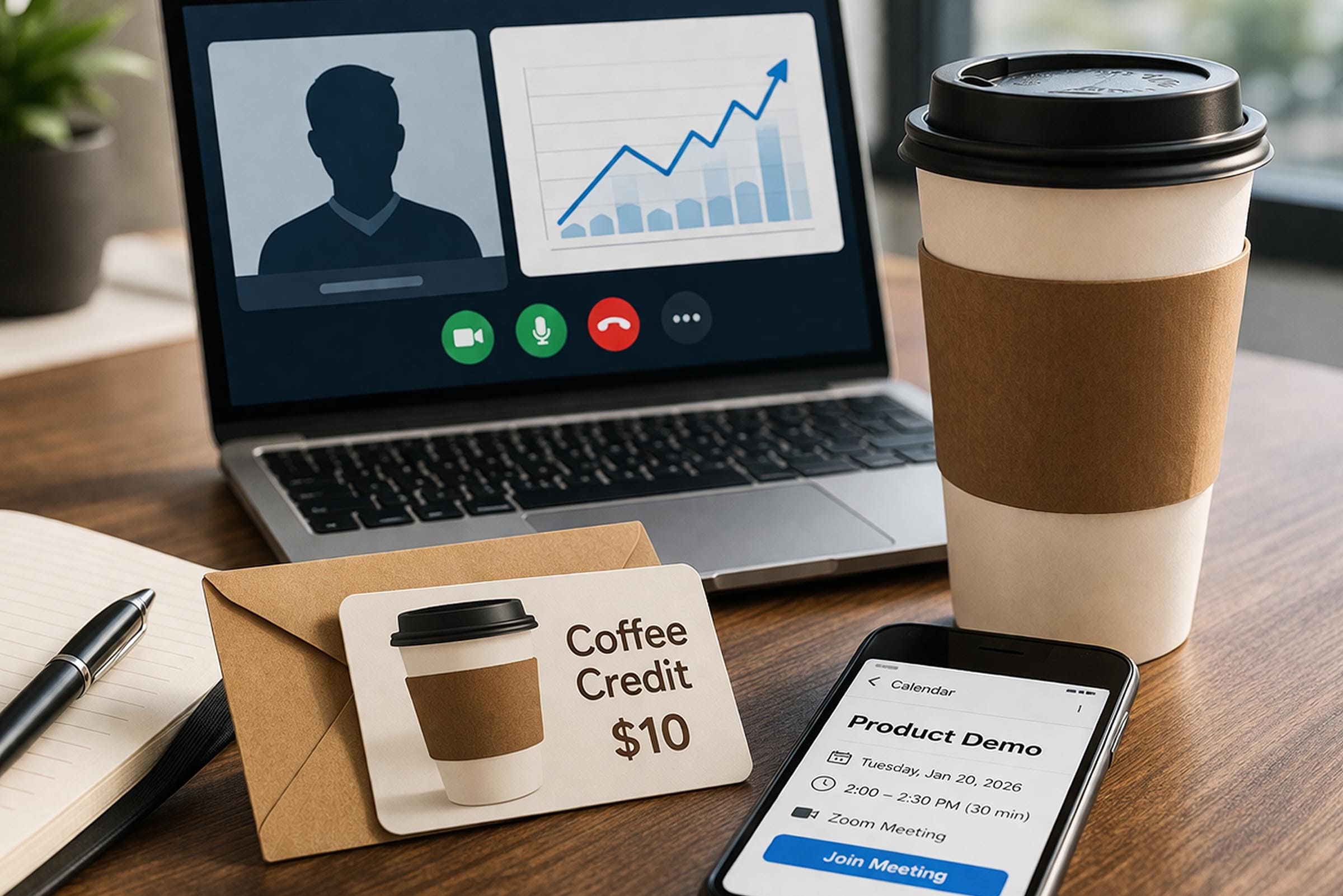
The best way to incentivize prospect attendance without looking desperate is to frame your outreach around value exchange rather than giveaways – sending a small, thoughtful gesture (like a coffee or lunch credit) that acknowledges their time investment while keeping the focus on the business conversation. This approach has helped sales teams increase demo show rates by 20-35% while maintaining professional credibility.
Why Are Demo No-Shows Costing You More Than You Think?
The average SaaS sales team experiences a 20-30% no-show rate on scheduled demos. For a team booking 50 demos per month, that’s 10-15 wasted calendar slots, hours of prep time, and significant pipeline leakage.
The math gets worse when you factor in opportunity cost. If your average deal size is $25,000 and your demo-to-close rate is 25%, each no-show represents approximately $6,250 in unrealized potential revenue. Over a quarter, a 10-person sales team with typical no-show rates could be leaving $500,000+ on the table.
The Psychology Behind No-Shows
Prospects don’t skip demos because they’re malicious. They skip because:
- Competing priorities pushed your meeting down the list
- No immediate consequence for not attending
- Low perceived commitment to an event they booked days or weeks ago
- Forgetting entirely due to calendar overload
The solution isn’t aggressive reminder sequences or guilt-based messaging. It’s creating a micro-commitment that makes showing up the path of least resistance.
What Are the Best Tactics to Increase Demo Show Rates
1. Pre-Meeting Gesture Strategy
Sending a small token of appreciation before the meeting – not as a bribe, but as a genuine acknowledgment of their time – creates psychological reciprocity. The key is timing and framing.
Best practice: Send a $5-10 coffee or snack credit 24-48 hours before the scheduled demo with messaging like: “Grabbed you a coffee for our chat tomorrow. Looking forward to showing you how [specific value prop].”
This approach works because it:
- Creates a tangible reminder of the upcoming meeting
- Establishes goodwill before the conversation begins
- Makes the prospect feel valued rather than “sold to”
Platforms like Thnks enable this in under 30 seconds with no need for the prospect’s mailing address – critical for maintaining speed in fast-moving sales cycles.
2. Calendar Optimization
When you schedule matters almost as much as what you send. Data consistently shows:
- Tuesday through Thursday demos have 15-20% higher show rates than Monday/Friday
- 10-11 AM and 2-3 PM in the prospect’s timezone perform best
- Shorter time slots (25 or 45 minutes vs. 30 or 60) signal respect for their time
3. Confirmation Sequence Engineering
Your reminder sequence should escalate value, not just frequency. A proven framework
- T-Minus 24 Hours (The “Value Add”):
- Send a short, relevant resource (a 1-page case study or a 30-second feature teaser video) related to their specific industry.
- Messaging: “Looking forward to tomorrow. Thought you’d find this [Resource] interesting—it covers exactly how we helped [Similar Company] solve [Problem].”
- The Morning Of (The “Agenda Sync”):
- Send a bulleted list of the 3 main points you plan to cover, based on your discovery. This makes the meeting feel organized and high-stakes.
- Messaging: “Ready for our chat at [Time]. I’ve tailored the agenda to focus on [Point A] and [Point B]. See you soon!”
- 15 Minutes Before (The “Friction Reducer”):
- A simple, text-based nudge with the direct meeting link.
- Messaging: “Just popping this to the top of your inbox. Here’s the link for our [Time] demo: [Link].”
4. Personalized Stakes
Generic demos get generic commitment. When prospects see you’ve done homework specific to their situation, the perceived value of attending increases.
Before each demo, identify:
- One specific challenge from their LinkedIn activity or company news
- One competitor or peer company using your solution
- One metric improvement relevant to their role
Reference these in your pre-demo outreach to demonstrate the meeting won’t be a templated pitch.
5. Easy Rescheduling Over Cancellation
Make rescheduling frictionless. Include a one-click reschedule link in every reminder rather than forcing prospects to email back. A rescheduled demo is infinitely more valuable than a ghosted one.
Comparing Demo Incentive Approaches
The best demo incentive strategy for SaaS sales teams is a digital gesture platform that combines speed (no address collection), reasonable cost ($5-15 range), and personalization. Thnks reports 90% open rates on gestures sent through their platform, significantly higher than email-only touchpoints.
| Feature | Thnks | Sendoso | Postal.io | Traditional Gift Cards |
| Send Time | Under 30 seconds | 2-5 business days | 1-3 business days | Varies (mail/in-person) |
| Recipient Address Required | ❌ No | ✅ Yes | ✅ Yes | ✅ Yes |
| CRM Integration (Salesforce/HubSpot) | ✅ Native | ✅ Native | ✅ Native | ❌ No |
| Price Range per Gesture | $5–$150 | $15–$500+ | $10–$300 | $10–$100 |
| Compliance & Spending Controls | ✅ Built-in | ✅ Available | ⚠️ Limited | ❌ No |
| Open/Engagement Tracking | ✅ 90% open rate | ⚠️ Delivery tracking only | ⚠️ Delivery tracking only | ❌ No |
Compliance and Tracking Considerations
Enterprise sales teams need to consider:
- Gift policy limits: Most prospects have $50-100 thresholds; staying in the $5-25 range avoids compliance friction
- CRM integration: Tracking which gestures were sent and their correlation to show rates enables optimization
- Team-wide visibility: Managers need spending oversight without micromanaging individual reps
The best gifting platform for sales team compliance offers built-in spending limits, approval workflows, and native CRM integrations. Thnks integrates directly with Salesforce and HubSpot, allowing gesture sends to be logged automatically against opportunity records.
Measuring What Matters
Track these metrics weekly to optimize your approach:
- Show rate by rep: Identify top performers and replicate their approach
- Show rate by gesture type: Does coffee outperform lunch credits?
- Show rate by timing: Morning vs. afternoon, day of week
- Cost per attended demo: Total gesture spend ÷ demos attended
- Gesture-to-close correlation: Are attended demos following gestures converting at higher rates?
With 1,000+ vendor options in platforms like Thnks, you can A/B test different gesture types to find what resonates with your specific buyer persona.
FAQ
The optimal range for demo incentives is $5-25 per prospect. This amount is meaningful enough to create reciprocity but low enough to avoid triggering corporate gift policies (typically $50-$100 thresholds) or appearing excessive. At scale, budget $500-1,500 monthly for a team booking 100 demos.
Send your gesture 24-48 hours before the scheduled demo. This timing is recent enough to serve as a reminder while giving the prospect time to redeem it before your meeting. Sending too early (5+ days) reduces the connection to your upcoming conversation.
Yes, but calibrate appropriately. Enterprise buyers are accustomed to vendor outreach and often appreciate gestures that acknowledge their time without being lavish. Coffee, lunch delivery, and small charitable donations in their name perform well. Avoid anything that could be perceived as attempting to influence a procurement decision.